Three inventions from Fabriano changed the history of paper
Watermarks, animal-gelatine sizing and hammer mills: in the Middle Ages, Fabriano turned an ancient material into a tool of the modern West.
Sources consulted:
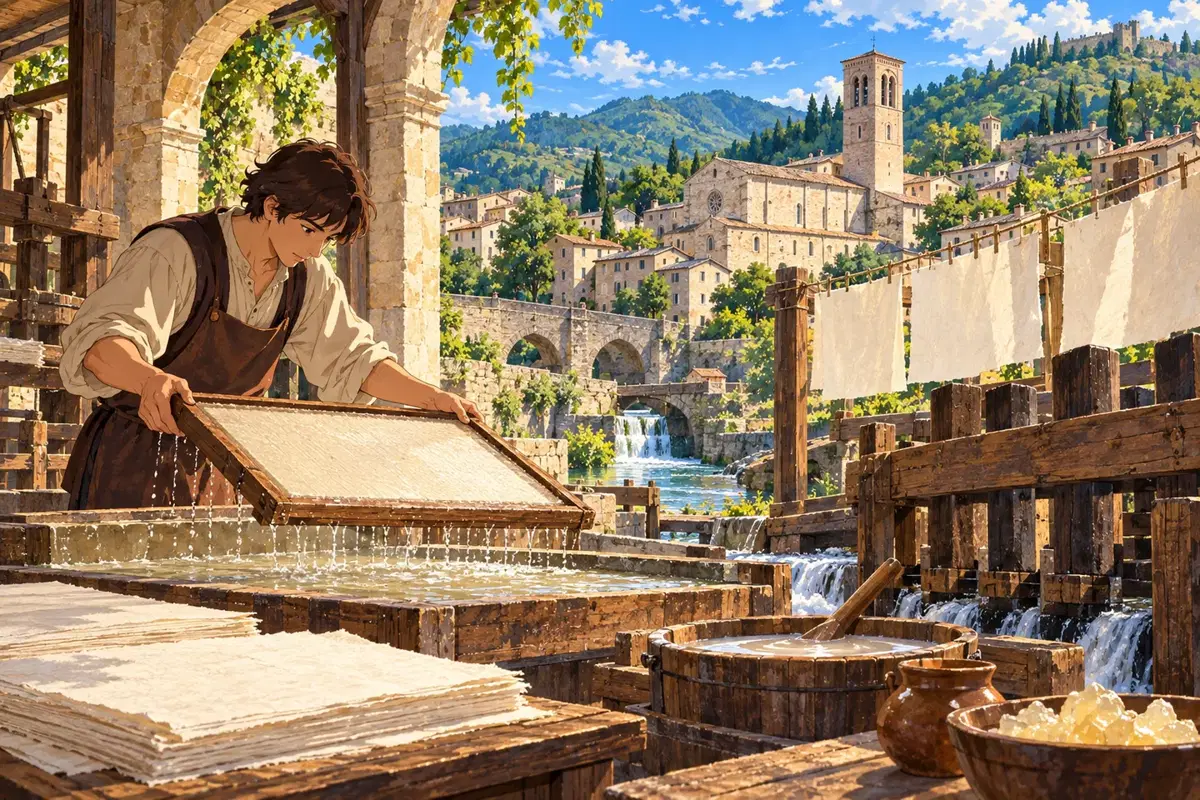
One sheet, three changes
Fabriano did not invent paper itself. Its contribution was to improve medieval production through water-powered hammers for rags, animal-gelatine sizing and watermarks: changes affecting the sheet’s texture, durability and identity. [1]
Rags had to be selected and processed rather than discarded. Following them reveals a town where river, workshops and trade worked together. Before the written page came water, fibres and skills passed on through repeated gestures. [2]
A signature hidden in light
A watermark appears when paper is held to the light. Made through the mould, it identified the maker. It is not a later printed design, but part of the paper’s structure, making quality a recognisable promise to buyers. [1]
The Paper and Watermark Museum, housed in the former Dominican convent, reconstructs a medieval paper mill. Finished sheets alone miss the most revealing part: how an uneven material becomes a surface for writing, drawing and preserving memory. [2]
From the museum to the papermakers’ town
Check official booking options and tour language. If you want a practical activity, confirm it is included: a collection visit and a workshop are not necessarily the same experience, particularly for families and groups. [3]
After the museum, walk through central Fabriano and look for connections between production and urban life. A handmade sheet becomes a more meaningful souvenir when you understand the tools, time and people behind it.