Enrico Mattei: from the Marche to the oil challenge
From Acqualagna to Matelica, from a tannery to the founding of Eni: the story of the man from the Marche who changed Italian energy policy, and places that preserve his memory.
Sources consulted:
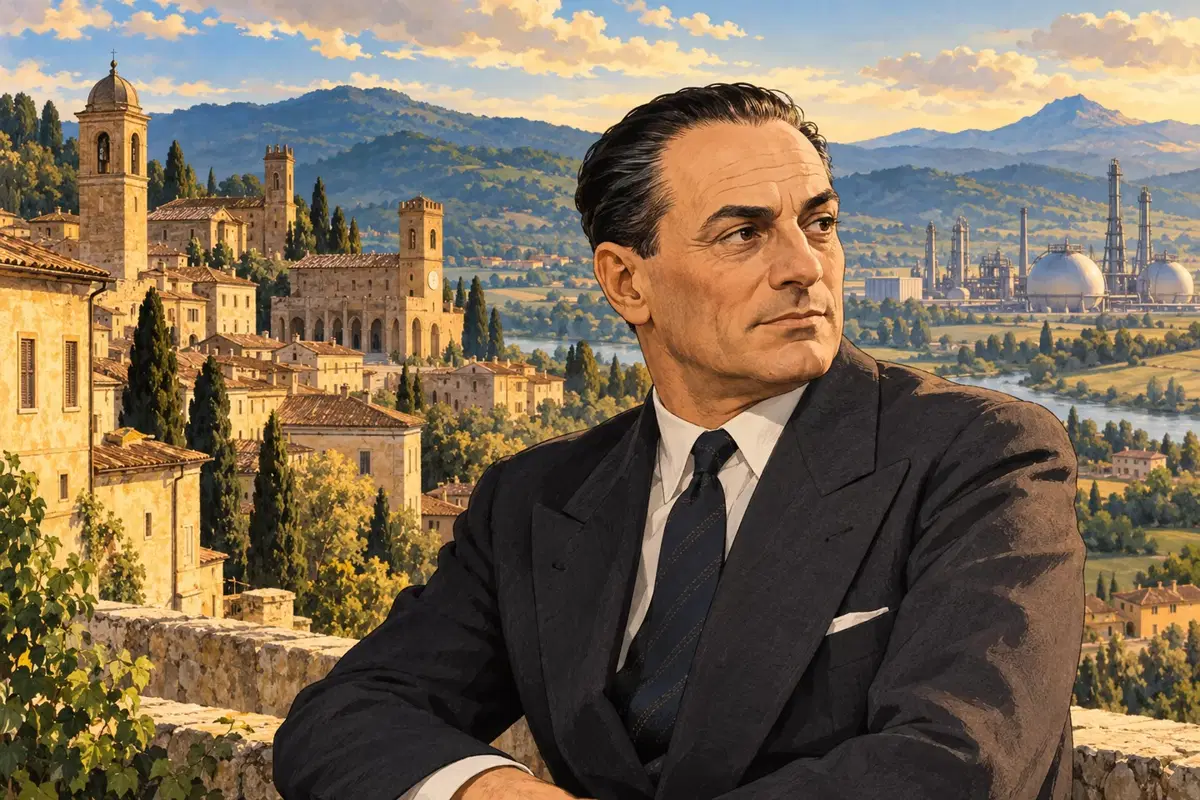
Two towns in the Marche, a story reaching far beyond
Before the oilfields and international negotiations come two names on the map of the Marche: Acqualagna and Matelica. Enrico Mattei was born in Acqualagna on 29 April 1906; he grew up and began working in Matelica, where his family had moved. His story began inland, far from the great centres of finance and industry. [1][2]
He joined Matelica’s Fiore tannery as an errand boy and learned the chemical processes involved in leather production, progressing to technical responsibilities. Milan and his own business followed. During the Resistance he helped organise Catholic partisan formations. The future Eni chairman was thus shaped by industrial work, private enterprise and political commitment: different experiences that help explain his ability to navigate both factories and institutions. [1][3]
Reviving Agip and founding Eni
In 1945 Mattei was appointed extraordinary commissioner of Agip with instructions to liquidate it. Instead, he backed its revival, focusing on hydrocarbon exploration and methane in the Po Valley. In his vision, energy was a means of rebuilding Italy and supporting its industrial development. On 10 February 1953 the Ente Nazionale Idrocarburi was established, with Mattei as its first chairman. [2][4]
The challenge continued abroad in a market dominated by the major companies known as the Seven Sisters. Mattei sought direct relationships with producing countries. The arrangement used in the 1957 Iranian agreement combined an equally owned company with taxes and royalties: Iran received 75% of total profits and Eni 25%. It was not a promise of free oil, but a different economic balance between the company and the country holding the resources. [5]
27 October 1962 and places of remembrance
On 27 October 1962 Mattei died when his aircraft, arriving from Catania, crashed at Bascapè near Pavia. Pilot Irnerio Bertuzzi and journalist William McHale also lost their lives. Treccani’s biographical account distinguishes the initial finding of an accident from the later investigation, reopened in 1995 and closed in 2003, which supported sabotage. Those who ordered it were not identified: economic rivalries alone do not establish responsibility. [6]
To follow this story in the Marche, start at his birthplace in Acqualagna, now a multimedia museum displaying documents and personal belongings. Matelica’s main square bears his name; in Braccano, the Don Enrico Pocognoni Museum explores the local Resistance, with Mattei among its protagonists. These are different stops: the house focuses on the person, while the Braccano museum explains the context of the struggle for Liberation. Confirm opening times and access arrangements with each venue before visiting. [7][8][9]