Before Rome, the Piceni lived in Le Marche
Warriors, burial grounds, Adriatic trade and a culture whose traces stretch from the Foglia to the Tronto: a journey into the earliest origins of the Marche.
Sources consulted:
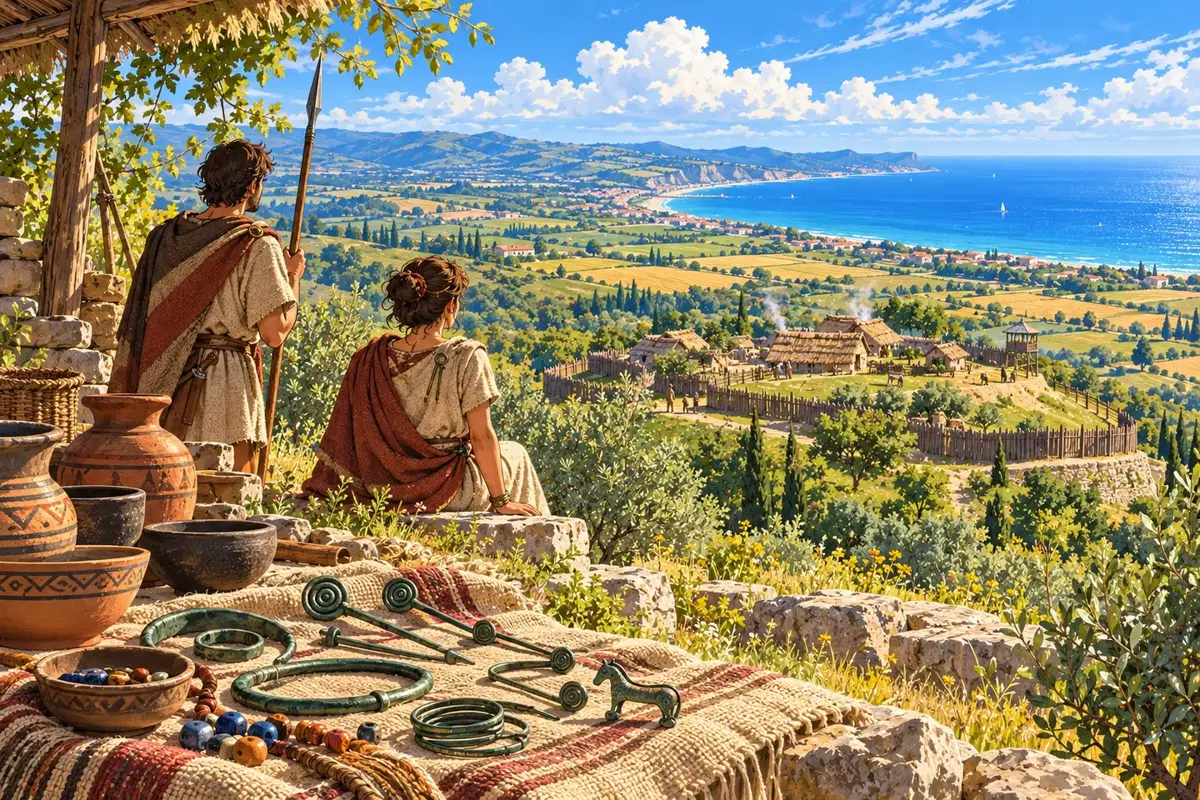
Before the Roman roads
Before reading the Marche through Roman cities, pause with the Picenes. The National Archaeological Museum of the Marche places their civilisation at the heart of its route: grave goods, ornaments and material evidence reveal middle-Adriatic communities as more than a prelude to Rome. [1]
Do not imagine a uniform state with one capital. Ascoli’s museum describes numerous villages and traditions. Grave goods reveal individuals and community choices, but cannot by themselves establish identical customs, wealth or roles for everyone. [2]
The legendary woodpecker and archaeological graves
Ancient tradition links the Picenes’ name to a woodpecker sacred to Mars guiding migration from Sabina. The museum explicitly calls this a legend: an origin story worth knowing, but not a journey demonstrated step by step through excavation. [2]
Burials provide material evidence for comparison. Ascoli’s museum distinguishes Picene pit graves from cremation evidence linked to Villanovan culture. Pre-Roman Italy was a mosaic: similarities and contacts do not remove the need to recognise different contexts. [3]
Choosing a first Picene stop
Start in Ancona or Ascoli Piceno and allow time for one collection. Check which sections are actually open: Ancona’s ministerial page reports display works and updates. An object belonging to a collection is not necessarily on view on your chosen date. [1][4]
Continue with a specific story such as Novilara or Numana’s queen. Comparing objects, burial sites and landscape makes Picene civilisation tangible. Rather than squeezing every place into one day, follow one question carefully and leave with another reason to return.