Entire Roman cities lie beneath the fields of the Marche
Sentinum, Suasa, Potentia, Urbs Salvia, Falerio: many major ancient settlements never became modern cities and now re-emerge as archaeological landscapes.
Sources consulted:
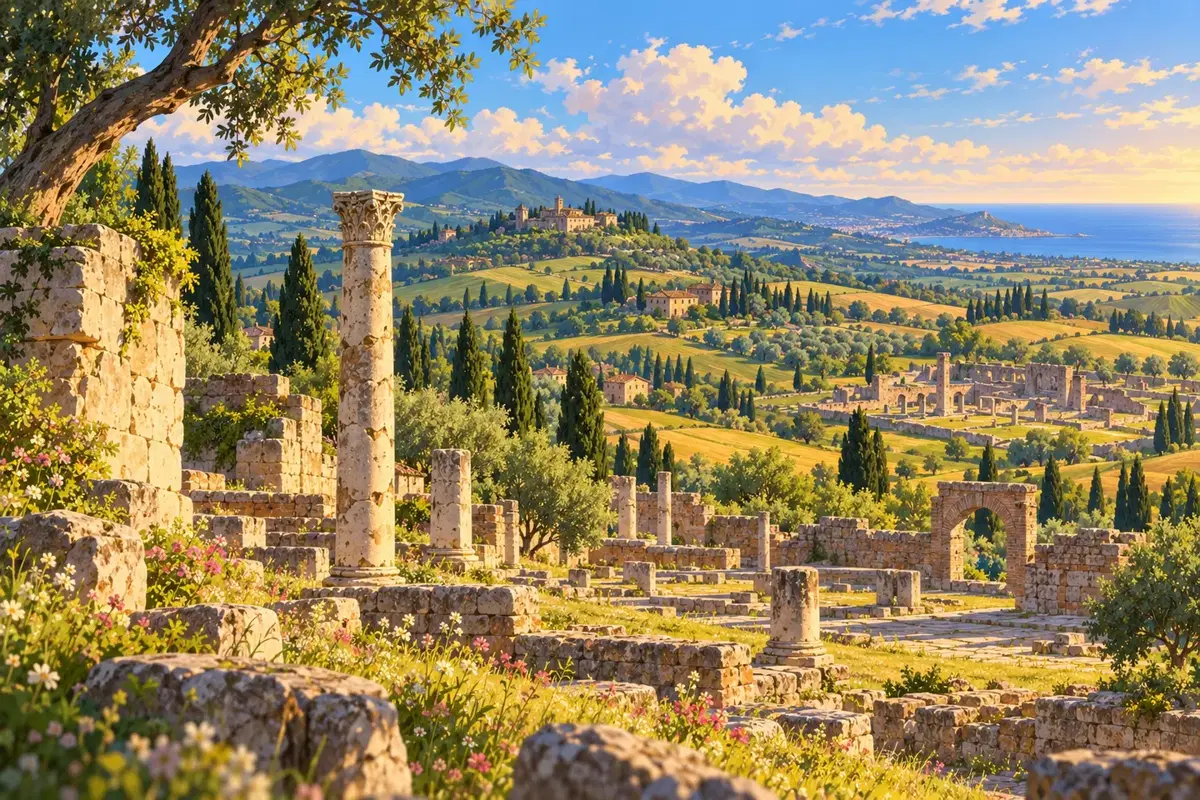
Cities we now read in the ground
In Marche’s valleys, Roman settlements do not always coincide with modern town centres. Remains may emerge in fields, below a hill town or along an ancient route. “Vanished cities” is an evocative shortcut: visitors see portions of urban systems, preserved differently and reconstructed by archaeologists from traces and objects.
Urbs Salvia, below Urbisaglia, reveals a varied city: theatre, amphitheatre, water structures and temple precinct served different functions. The route concerns more than monuments and entertainment: it shows the work needed to supply and organise a community. Not everything was visible together or has been excavated. [1]
A house at Suasa, a city near San Severino
At Suasa in the Cesano valley, the Domus dei Coiedii reveals domestic life and displays of prestige. Mosaic floors are more than stone carpets: they distinguish rooms, tastes and investment in a residence whose heyday came in the early second century AD. [2]
Septempeda lies east of present-day San Severino Marche, near Santa Maria della Pieve. The gap between Roman site and later town makes settlement change tangible. Every abandonment need not result from one invasion: economic networks, power centres and habitation changed, with each site requiring its own history. [3]
Visit park and museum together
For a first encounter, choose one site and its associated museum when open: the ground reveals spaces, while displays provide objects, inscriptions and decoration. At Suasa, the park and Museo Casagrande complement each other, one in the valley and the other in Castelleone’s centre. [4]
Check each area’s current access: park and museum may open separately, and works may affect individual sections. Official pages distinguish visitable areas from displays being renewed. Suitable shoes and a guide make the remains more rewarding than a quick collection of photographs. [1][4]