The Novilara stele tells of a battle 2,700 years ago
Ships, warriors and a scene carved into sandstone: near Pesaro, one of pre-Roman Italy’s most enigmatic images came to light.
Sources consulted:
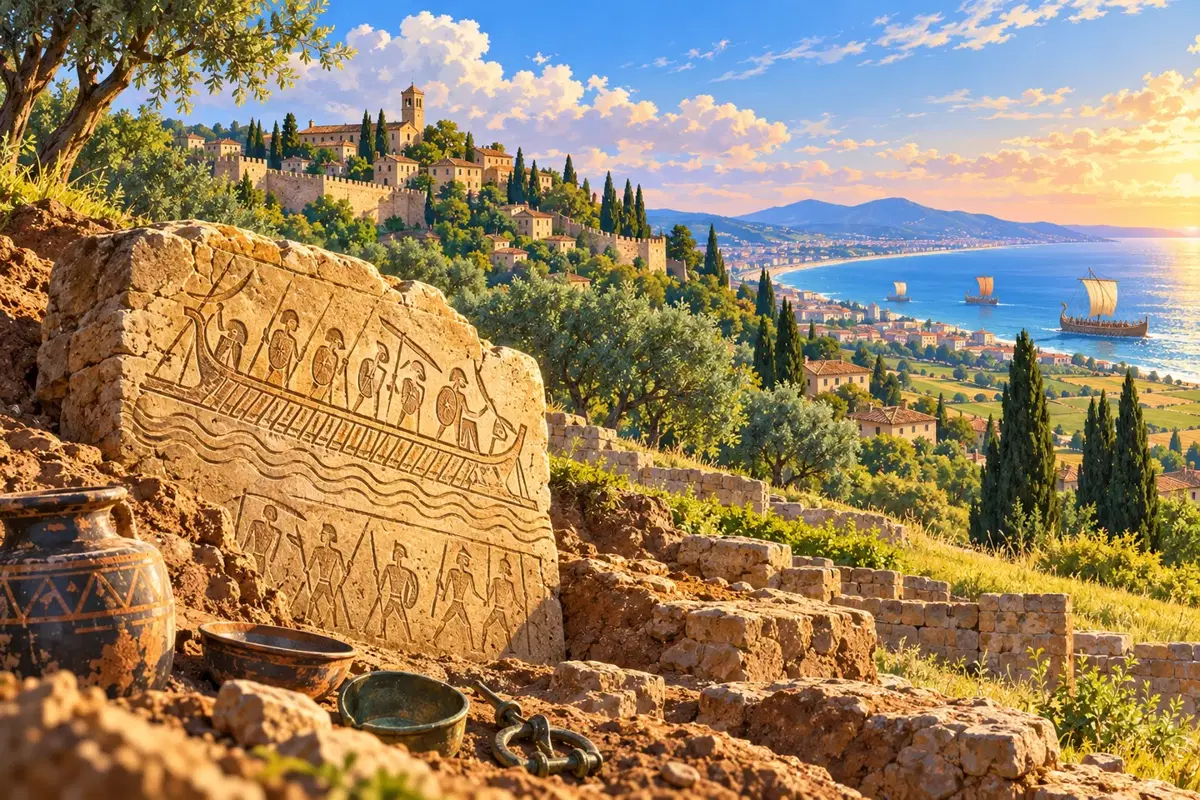
A scene found in 1866
The naval-scene stele in Pesaro’s Museo Archeologico Oliveriano was found in 1866 on San Nicola in Valmanente hill. The municipality notes that the circumstances are unknown: an object without a secure context cannot answer every question it raises. [1]
Novilara’s documentation centre dates it between the late seventh and sixth centuries BC, before Roman Pisaurum. It makes an Adriatic traversed by boats visible, rather than presenting the sea as an empty edge of history. [2]
Clear images, open questions
The scene is commonly described as a naval battle. It invites questions about navigation and conflict but does not identify the participants, place or date of a specific event. The gap between carved evidence and reconstruction is part of its archaeological fascination. [1][2]
Names also matter: the naval stele should not be confused with the inscribed Novilara stele held in Rome. These are different objects. Combining them automatically would turn separate historical and linguistic questions into a single mysterious object that does not exist in that form. [3]
From stone to Novilara’s landscape
Visit the Oliveriano to see the original and check its current visitor information. The route also covers Novilara’s necropolis, the lucus pisaurensis sanctuary, Roman Pisaurum and eighteenth-century collecting, placing the stele within the territory’s broader history. [1]
Plan Novilara as a separate stop: its documentation centre holds a wooden model of the depicted ship. Comparing object and model distinguishes evidence from modern interpretation. Check that the centre is open before travelling, particularly if archaeology is your main interest. [2]