Macerata’s Temple of Opera Began as a Venue for an Almost Forgotten Sport
Before Aida and the Macerata Opera Festival, the Sferisterio was an arena for pallone col bracciale, circuses, parades and even bull hunts.
Sources consulted:
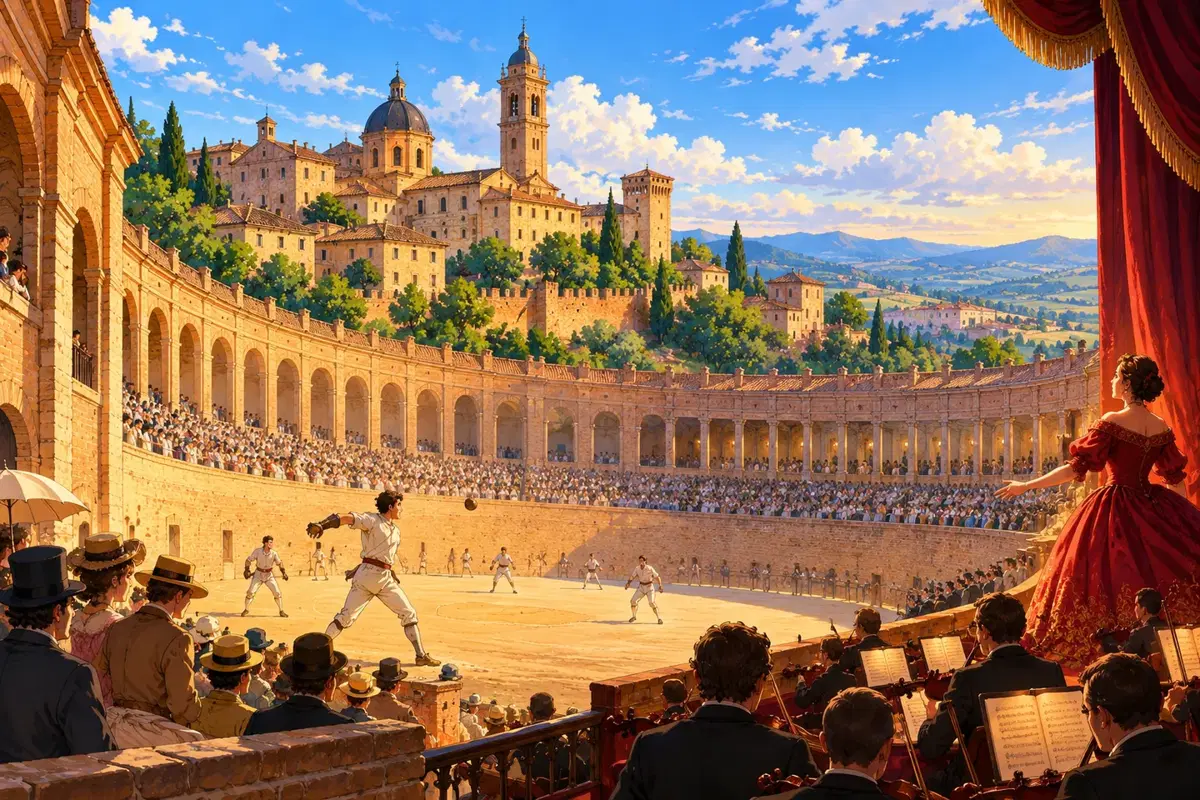
Before opera, a ball game
Macerata’s Sferisterio was built for pallone col bracciale and public entertainment. Seeing it only as an opera venue misses its shape’s meaning: an open-air arena whose long wall belonged to a sport before becoming a theatrical backdrop. [1]
Built between 1823 and 1829, it was funded by the Cento Consorti. The facade inscription remembers that civic participation. The monument records a shared investment in a place for gathering and enjoyment that represented the town, rather than an individual ruler’s residence. [1]
A shape finds new uses
The neoclassical design is associated with Ireneo Aleandri. The relationship between playing area, seating and wall still reveals the original function, unlike an enclosed theatre. Observing this before a performance changes how you see the staging too. [1]
Today the Sferisterio hosts the Macerata Opera Festival. This transformation does not erase its sporting past but brings it into dialogue with large-scale staging, music and open space. Continuing public use makes it more than a monumental backdrop. [2]
Enter the arena, then explore the centre
Choose between a monument visit and a performance, checking their separate arrangements through official channels. A visit ticket is not a festival seat. Events may change access to spaces, so check before planning the rest of your day. [2]
Add Piazza della Libertà and the Civic Tower to explore Macerata’s public spaces: arena, square and panorama. For an evening performance, walk beforehand so you can enjoy the town without rushing through it afterwards.