Around San Severino, a scattered medieval landscape survives among towers and castles
The San Severino area is dotted with fortifications and hilltop settlements that reveal centuries of control over valleys and inland routes.
Sources consulted:
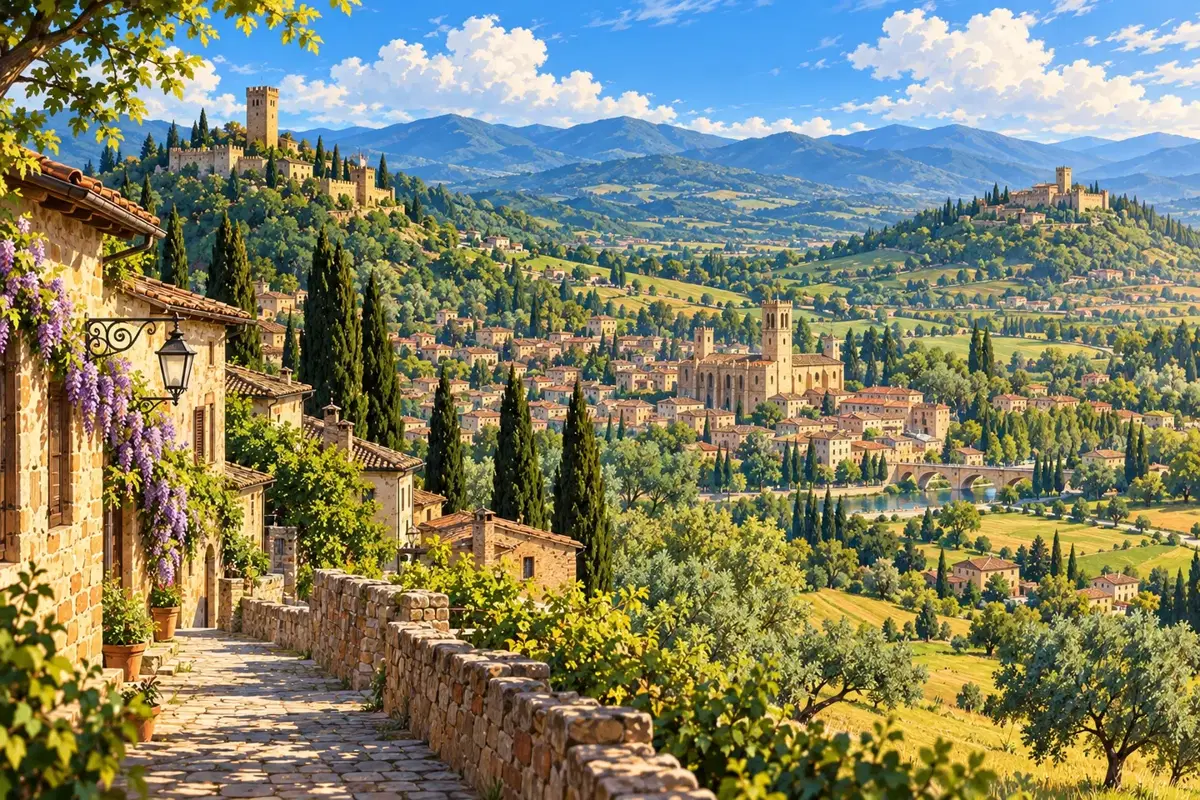
The Middle Ages beyond the square
San Severino Marche is best understood beyond its town centre. Castles and hilltop settlements reveal a dispersed medieval organisation. They are more than scenery: position, visibility and connections explain why living in and defending a place were closely linked. [1][2]
At Castello al Monte, on Monte Nero, the municipal tower later named after the Smeducci was built in the thirteenth century. The town tourism portal recalls defence, lookout and signalling functions: a building could also be an instrument of communication. [1]
Pitino and the language of towers
Pitino preserves a 23-metre tower and traces of a wall circuit roughly 400 metres long. These dimensions help imagine the original settlement, but do not mean the entire medieval complex survives intact or every structure can be entered today. [2]
The municipal description distinguishes medieval elements from later rebuilding and additions. A castle is not a frozen photograph of one century. Serralta likewise preserves a history of conflict and transformation linked to the Smeducci family. [2][3]
A landscape itinerary
For a first exploration, choose Castello al Monte and one countryside stop rather than accumulating names on a map. Compare their positions and relationships with valleys and roads: the landscape becomes part of the historical account. [1][2]
Ask the tourist office about access, path conditions and building openings. A tower or church in the description does not guarantee interior access. Wear shoes suitable for uneven ground and distinguish an exterior village visit from a walk between rural settlements. [1][2][3]