Frasassi, 1971: when the mountain revealed a hidden world
A discovery, a mountain and the slow work of water. The story of the caves of Genga, before you descend to visit them.
Sources consulted:
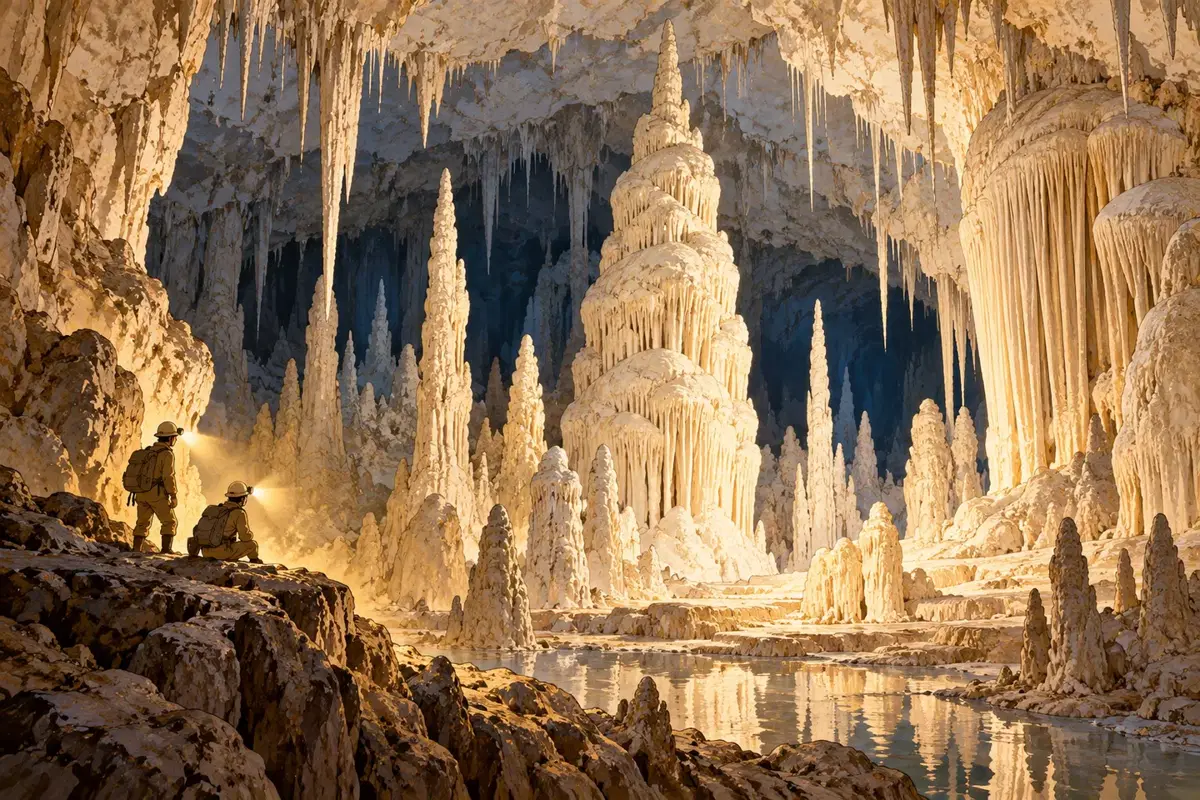
1971: a discovery that changed the scale of things
Frasassi is more than a cave to visit: it is a story of exploration. On 25 September 1971, the CAI speleological group from Ancona discovered the Grotta Grande del Vento in the municipality of Genga. An opening in the mountain revealed an underground world that would become one of the landmarks of Le Marche. [1]
However, 1971 was not the first encounter with all the caves in the area. The entrance to the Grotta del Fiume had already been identified in 1948 by Mario Marchetti, Paolo Beer and Carlo Pegorari. Distinguishing these episodes helps us understand Frasassi as a cave system, and its discovery as a succession of explorations. [2]
Water is the real protagonist
Inside the mountain, water works in two ways: it helps shape the cavities and deposits minerals that build new formations. Hanging stalactites, stalagmites rising from the floor and mineral flows along the walls reveal different but connected processes. The contrast between empty space and solid matter makes the landscape of Frasassi so striking. [1][3]
A mineral formation is not a sculpture carved by a person: it is the result of successive deposits. The official website describes an environment where mineral formation continues today. This underground world is not a motionless backdrop. [3]
From the story to the visit
The tourist route lets you explore this landscape with a guide. The operator gives a length of about 1,500 metres and a duration of 75 minutes. The temperature inside stays around 14°C throughout the year; shoes with good grip and a warm layer make the visit more comfortable. [4]
An equipped route is not the same as a route without obstacles: accessibility varies between chambers. Before setting out, check arrangements suited to your needs directly with the operator, along with opening times, tickets and visits in other languages. Observe the formations without touching them: their conservation is part of the experience. [4]