Beneath Fermo lies a city you cannot see
Thirty Roman chambers hidden below the historic centre: the great cisterns reveal Firmum Picenum's sophistication two thousand years ago.
Sources consulted:
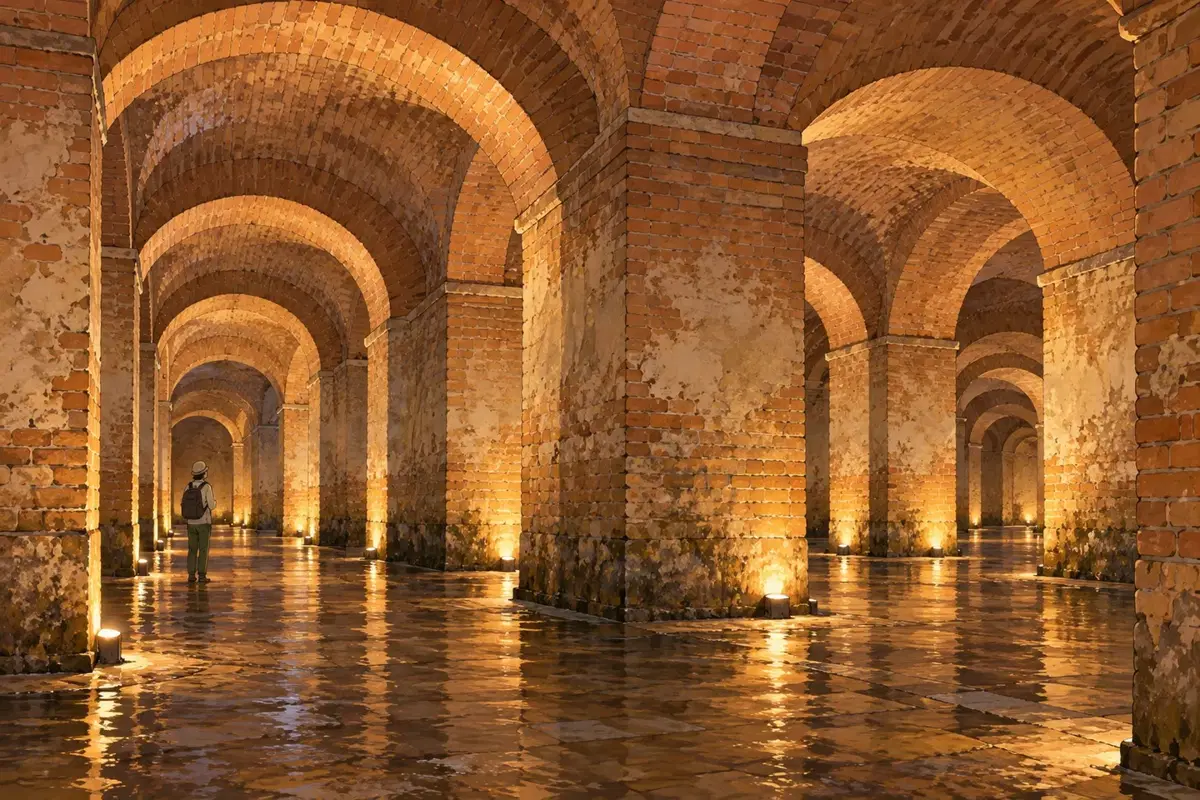
Firmum Picenum had a hidden reserve
Beneath central Fermo survives a Roman water infrastructure built between the first century BC and first century AD. The cisterns were not an inhabited underground district: they collected and stored water. “Hidden city” is an evocative image, provided it does not obscure their function. [1]
The complex contains thirty chambers in three rows over about 2,200 square metres. Repetition can feel labyrinthine, but reflects functional design. Before seeking a photograph, notice the ordered sequence: spatial organisation itself creates the spectacle. [1][2]
Engineering written on the walls
Waterproof wall coatings are a key to the visit. Local sources describe opus signinum, or cocciopesto, a technical solution for retaining water. It is functional rather than decorative: an answer to the essential urban problem of storing a resource without losing it. [2]
Visit Fermo records some chambers remaining in use into the 1980s. This does not mean every part always worked identically, but shows infrastructure spanning different eras. Underground, a history of usefulness and adaptation accompanies the dramatic arches. [2]
Down to the cisterns, back to the square
Follow current Fermo Musei instructions: its page lists access through the Civic Archaeological Museum at Via Paccarone 36. Do not automatically use an entrance from older guides. Check guided arrangements, availability and accessibility with the ticket office before visiting. [3]
Back outside, reach Piazza del Popolo and see the city continuing above its Roman infrastructure. Add Palazzo dei Priori or Teatro dell’Aquila, checking their openings separately. Moving between underground engineering and civic spaces reveals Fermo’s layers without forcing everything into one era.