Why is Cingoli called the Balcony of Le Marche?
From a terrace on the walls, the view stretches across hills and the Apennines and, on clear days, reaches the Adriatic.
Sources consulted:
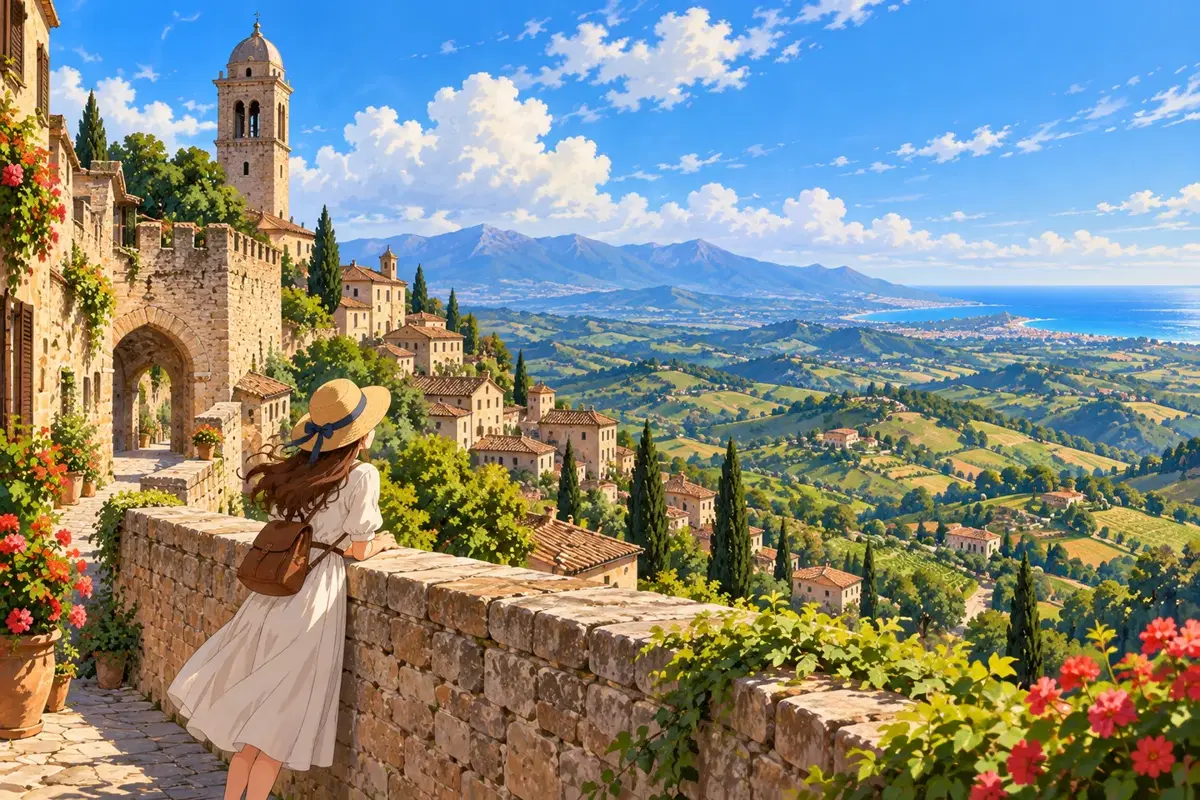
A nickname born from the landscape
The nickname “Balcony of the Marche” describes Cingoli’s position above a broad landscape of hills. No absolute geographical record is needed to appreciate it. Its power lies in making the succession of ridges, farmland and settlements legible. [1]
From the walls, views depend on light, haze and weather. Looking slowly rather than simply seeking a photograph reveals how the town relates to its surroundings. The viewpoint becomes a small lesson in Marche geography. [1]
From the panorama to Lotto’s colours
Cingoli preserves another way of looking: Lorenzo Lotto’s Madonna of the Rosary, completed in 1539. Commissioned by the Dominicans for their church, the large canvas invites a transition from the panorama’s breadth to the density of a painted composition. [2]
To find it today, look to the Town Hall’s Sala degli Stemmi museum space, not automatically the church for which it was painted. Distinguishing original destination from present location avoids a wrong turn and reveals how artworks change context over centuries. [2][3]
Look far, stop nearby
Alternate an outdoor walk with a cultural stop. Check Sala degli Stemmi opening and whether the painting is on view, especially if it is your main reason for travelling. Ask specifically about access to the exhibition space if needed. [3]
The regional itinerary links Cingoli with Apiro, offering a way to extend the day without reducing the historic centre to one terrace. Leave time for lanes and changing perspectives, moving from the broad horizon to close-up details. [1]