Part of Rome's history was decided on the Metauro
In 207 BC, Hasdrubal Barca's army was defeated in Le Marche: a decisive battle of the Second Punic War that changed the peninsula's destiny.
Sources consulted:
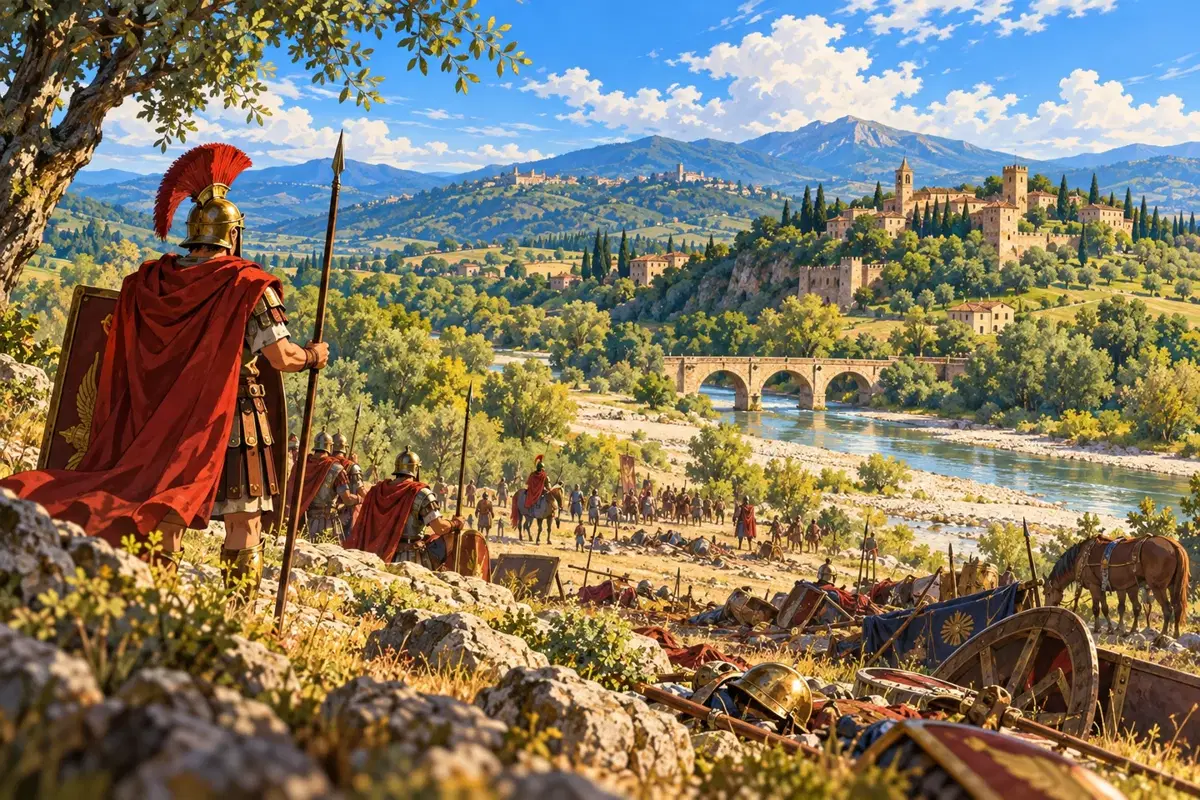
The reinforcements that never reached Hannibal
In 207 BC, the Metauro valley entered the history of the Second Punic War. Hasdrubal Barca had reached Italy to join his brother Hannibal, already fighting Rome. The strategic issue was preventing two Carthaginian armies from combining and increasing pressure on the Romans. [1]
Roman forces under consuls Marcus Livius Salinator and Gaius Claudius Nero defeated Hasdrubal, who died in battle. This ended a plan to unite armies, not the war itself. Fighting continued through the African campaign and Rome’s victory at Zama in 202 BC. [1][2]
A known event, a debated battlefield
Distinguish the battle’s existence from its precise location. Reconstructions propose different stretches of the valley: ancient accounts and landscape change do not establish one unanimously accepted field. A viewpoint may help imagine movements, but cannot by itself certify where soldiers fought. [3]
Spectacular details also need care. Army sizes, individual manoeuvres and transmitted stories are not equally verifiable. The clearest thread for visitors is the relationship between valley, crossings and connections: geography explains the stakes without turning every hypothesis into established fact.
Follow the valley, read the evidence
Connect the Metauro landscape with Roman Fano. The Civic Museum preserves a Gracchan boundary stone documenting management of public land in the Republican valley. It is not a battle artefact: it offers a different, evidenced way to understand Rome’s relationship with the territory. [4]
Check museum hours and authorised local routes, rather than seeking a guaranteed battlefield on private land. A guided visit can compare ancient sources with landscape interpretation. Asking where the battle happened remains an interesting part of research, not a flaw to hide from visitors.