A battle at Castelfidardo accelerated the creation of a united Italy
In September 1860, Piedmontese troops defeated the papal army: a decisive day in the Marche’s annexation to the Kingdom of Sardinia.
Sources consulted:
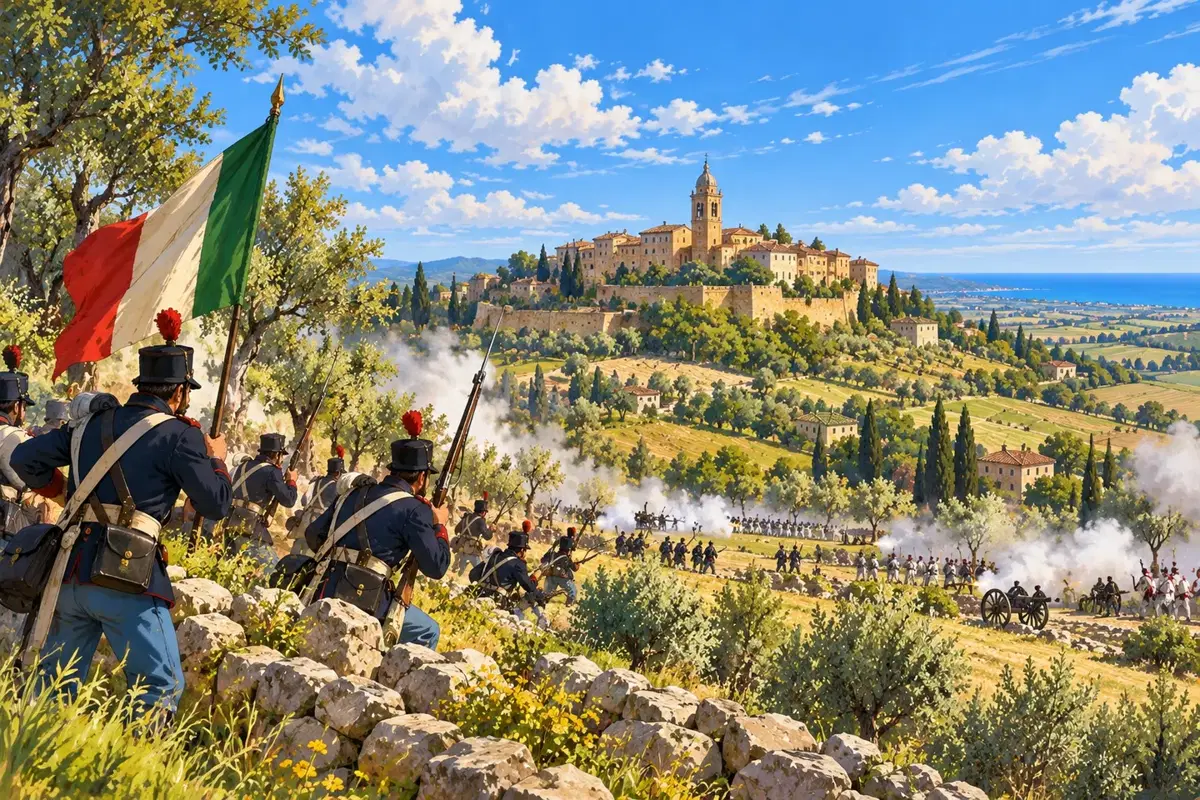
18 September 1860 in the Marche
The Battle of Castelfidardo took place on 18 September 1860 during the Sardinian army’s campaign in the Marche and Umbria. It was neither isolated nor the proclamation of the Kingdom of Italy, which followed the next year. The local museum places it within military operations and political changes central to unification. [1]
Papal forces under Lamoricière faced the Sardinian-Piedmontese army. The area between Castelfidardo and Loreto became a landscape of movement and fighting, not simply a map point. Understanding unit positions and objectives helps explain the events beyond identifying the winner. [1]
From battle to public memory
The Sardinian victory led towards the end of papal rule in the Marche and annexation to the Kingdom of Sardinia. The museum chronology continues to Ancona’s surrender on 29 September. Stopping at the battle day would omit its immediate consequences and the connection between local events and national history. [2]
The distributed museum includes exhibition rooms, the battlefield with its ossuary-shrine, and Vito Pardo’s National Monument of the Marche from 1910. Each tells something different: documents reconstruct events, the ossuary remembers the dead, and the monument expresses a later era’s celebration of victory. [2]
Visiting without losing context
Begin at the Risorgimento Museum to understand the historical reconstruction, then consider other stops. Check access and tours: a distributed itinerary includes both outdoor places and exhibition rooms. For mobility needs, ask separately about each location rather than assuming identical conditions. [2]
Combine the history with the Selva di Castelfidardo or the town centre, respecting marked routes and rules. Allow time for reflection: a battle is more than a celebration. Landscape, documents and burial places reveal both political change and its human cost.