The Arco di Traiano Was Not a Gate: It Was a Monument Greeting the Sea
One of Ancona’s Roman landmarks celebrates the emperor who expanded the harbour. Even today, it seems designed for those arriving from the Adriatic.
Sources consulted:
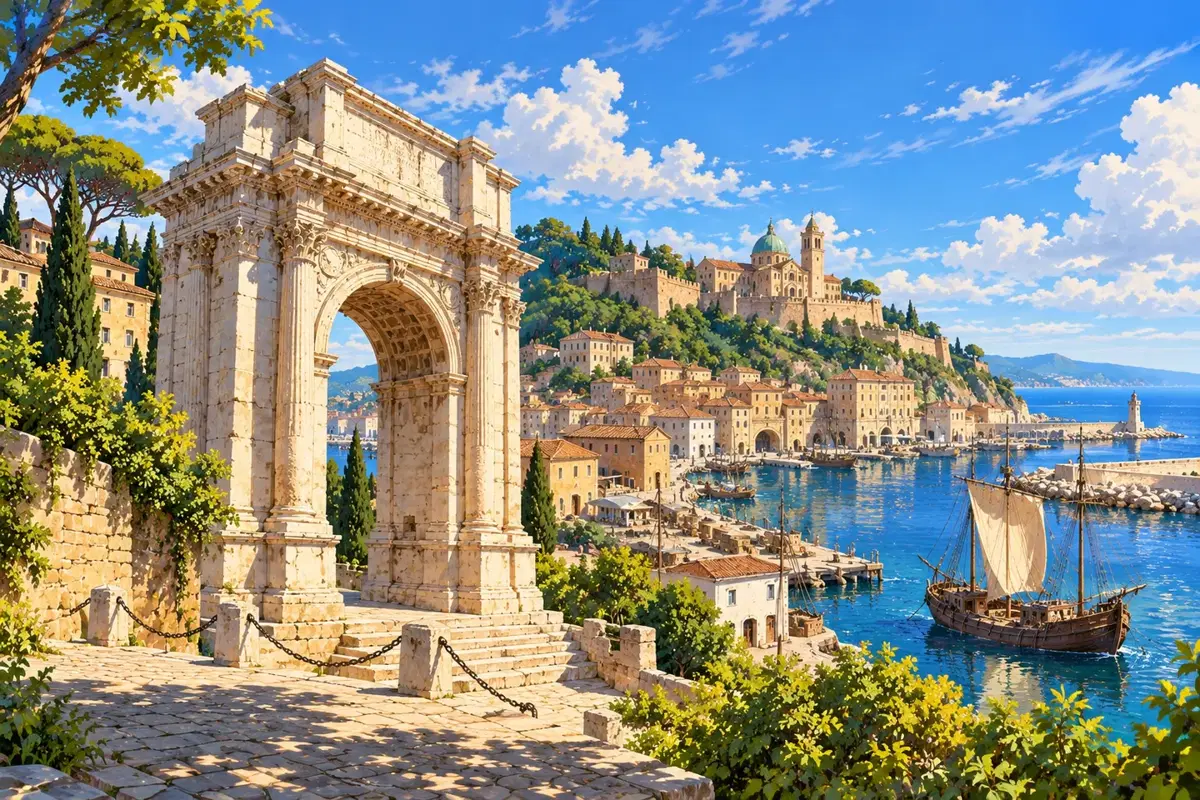
A monument, not a city gate
Trajan’s Arch stands beside Ancona’s old port, closely connected with the sea. The image of a gateway to the East is evocative, but the structure was not a gate in the city walls. It is an honorary arch for the emperor who promoted harbour safety and expansion. [1]
The port authority dates it to AD 115, within Trajan’s maritime works. Its design is traditionally attributed to Apollodorus of Damascus; attribution is not the same as a signed document. Its public message is clear: gratitude towards imperial power, made visible through architecture at the harbour. [2]
Reading marble and inscription
The municipality describes a slender, single-opening arch, built in marble blocks on a Conero limestone podium. Compare the opening with its supports and attic: proportions matter as much as decoration in understanding the monument’s effect within the harbour landscape. [1]
The land-facing inscription honours Trajan, accompanied by dedications to Plotina and Marciana. Reconstructions of the bronze statues once placed above remain hypotheses requiring caution. Missing elements should not be restored as certainties in the story: absence also reveals the monument’s transformations. [1]
A walk between two arches
The arch is an outdoor monument within the port. Follow authorised routes and safety signs; do not assume every level around the podium is accessible. The municipality notes wheelchair limitations inside the arch: check suitable routes and current conditions directly for specific needs. [1]
Continue to the Clementine Arch to compare two eras of the same port, then look towards Colle Guasco. Go beyond photographs: ask who commissioned each monument, whom it addressed and what image of the city it offered to people arriving by sea. [2]