Urbs Salvia is a Roman town that never entirely disappeared
A theatre, amphitheatre, walls and monumental structures still emerge in the Urbisaglia valley, revealing the scale of the ancient city.
Sources consulted:
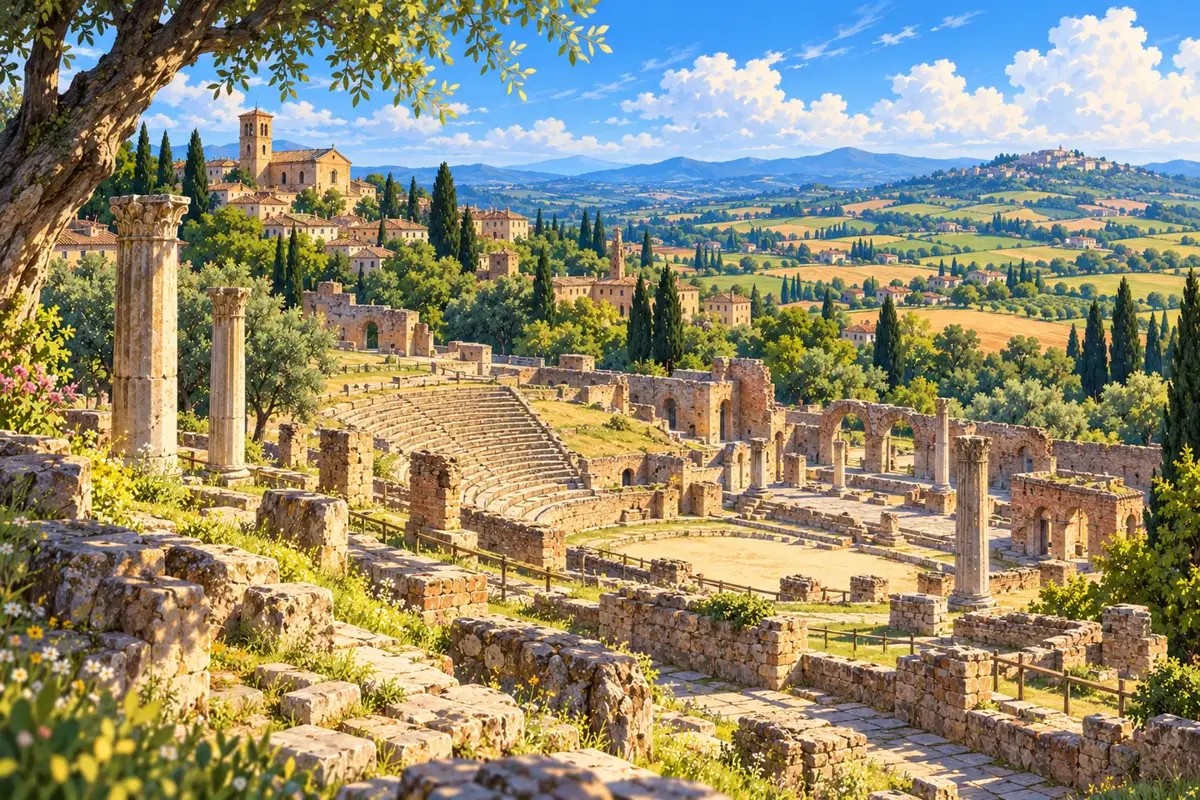
A city below Urbisaglia
Urbs Salvia’s park covers around 40 hectares below modern Urbisaglia. Its scale changes the visit: this is not one Roman building but a collection of monuments revealing different functions within a single urban organism. [1]
The medieval town and ancient city do not coincide. Viewed together, they reveal a changing inhabited landscape rather than an unaltered continuity. An archaeological visit identifies what survives, what is missing and the relationships still visible between structures. [1]
Performance, worship and propaganda
Key remains include the theatre, amphitheatre and temple-cryptoporticus complex dedicated to Salus Augusta. These places served different purposes: performance and worship occupied specific spaces. Recognising that distinction reconstructs public life beyond a generic picture of “Roman ruins”. [1][2]
The cryptoporticus preserves paintings associated with the Third Pompeian Style and imperial propaganda. Colour matters as much as walls: ancient architecture communicated through imagery and decorated surfaces, not only the bare volumes and exposed foundations visible today. [1][2]
Reading the remains on foot
Arrange your route with the operator: a monument’s presence in the park does not guarantee access at all times. The municipal itinerary links several Roman sites, but check individual areas, guided arrangements and path conditions before setting out. [2][3]
Consider terrain and distances between stops: this is an outdoor visit, not a sequence of museum rooms. Comfortable shoes, water and advance accessibility enquiries help you choose a suitable route. Complete the story with Urbisaglia’s historic centre. [1][3]