Pesaro's Teatro Rossini began inside the old ducal stables
Before becoming the theatre associated with Rossini, the site was linked to the Della Rovere stables. Its history spans almost four centuries.
Sources consulted:
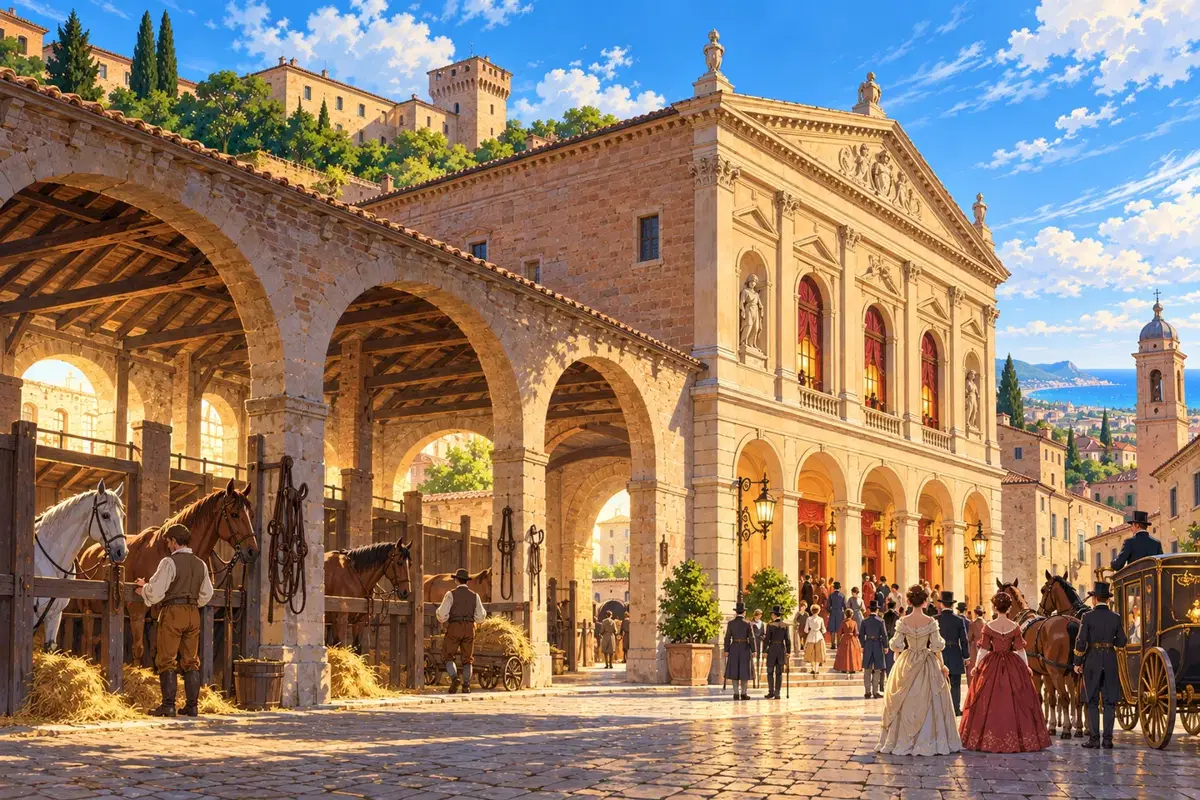
Before the theatre, the stables
Pesaro’s Teatro Rossini began with another name and a different auditorium. In 1637 it opened as Teatro del Sole, reusing former ducal stables granted to the community during Urban VIII’s papacy. The transformation was significant: a court building became a place for public performances. [1]
Later history includes extensions, rebuilding and changes to the entrance. Between 1816 and 1818 Pietro Ghinelli rebuilt the theatre, retaining some earlier elements. The Ministry of Culture identifies this as a decisive phase: the original reuse should not be mistaken for complete preservation of the stables. [2]
Rossini returns to his hometown
The Teatro Nuovo’s opening in 1818 featured La gazza ladra conducted by Gioachino Rossini himself. This was more than honouring a famous name: the composer took part in a specific moment in the theatre’s life. It was named after him later, in 1855, following another restoration. [1]
The horseshoe auditorium, stacked boxes and gallery follow the Italian theatre tradition. They show how the audience, visible from box to box, formed part of the spectacle. After earthquakes and closures, the 1980 reopening coincided with the birth of the Rossini Opera Festival. [1]
A visit to musical Pesaro
Check the programme and available tours before entering: rehearsals, stage work and performances can affect access. A show and a guided tour offer different readings of the building. Ask about access to your seat or route rather than judging it from the main entrance alone. [1]
Continue with Casa Rossini or the Museo Nazionale Rossini. Follow the thread connecting the musician’s life, the city that remembers him and the place where music comes alive. Your town walk becomes a thematic journey rather than a sequence of façades.