Federico da Montefeltro's studiolo: a room containing an entire Renaissance
Perspective marquetry, books, instruments, weapons and optical illusions: a small room in Urbino’s Palazzo Ducale reveals the Renaissance idea of a ruler.
Sources consulted:
A duke’s portrait beyond his face
In Urbino’s Ducal Palace, Federico da Montefeltro’s studiolo is a compact room expressing an entire idea of rule. The Gallery interprets it as the duke’s inner portrait: culture, virtue and intellectual choices become images. Beyond the reception rooms, power presents itself through knowledge and time devoted to study. [1]
The room is traditionally dated to 1476, recalled by the inscription below the ceiling. Rather than seeking a single signature, consider the coordinated work of painting, inlay and decoration. It is not a random collection of beautiful things: every element constructs Federico’s image as a learned ruler. [1]
Cupboards that seem to open
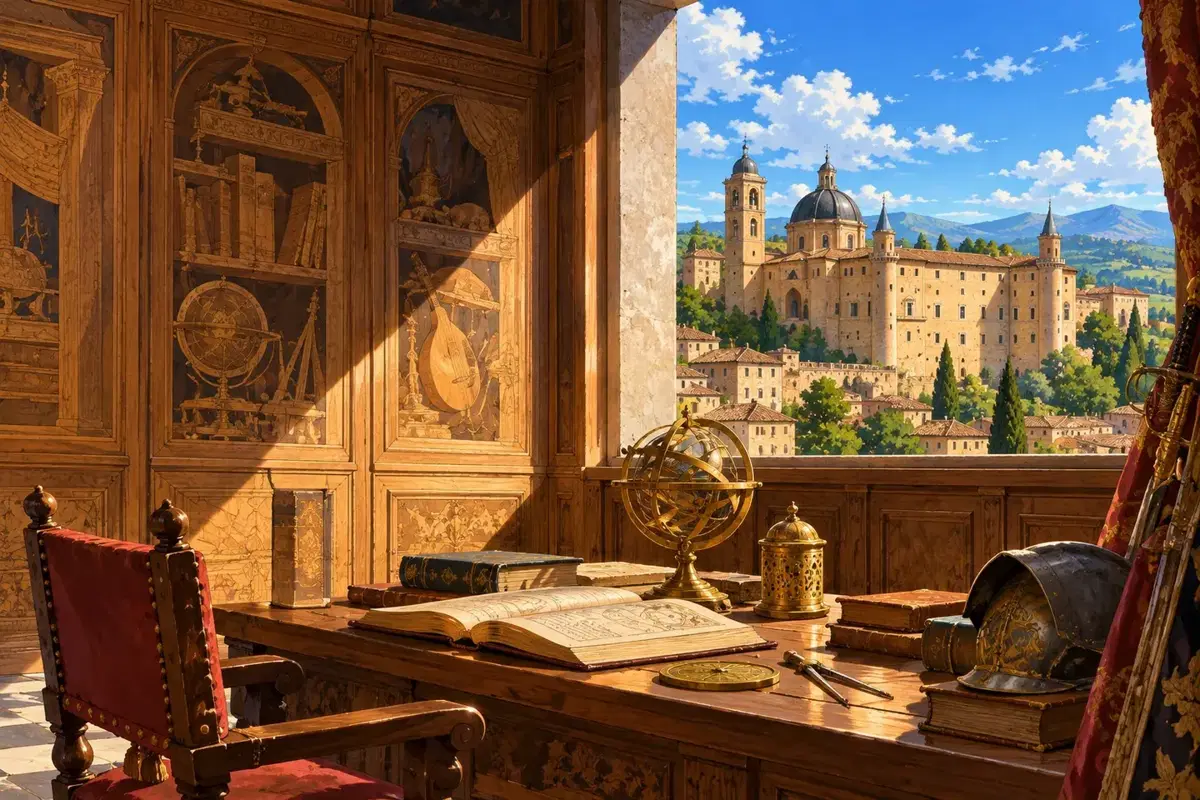
Wooden inlays use perspective to suggest doors, objects and depth: a flat surface persuades the eye to see space. Musical instruments, books and scholarly objects do more than display skill. They evoke the ruler’s disciplines and virtues, turning optical illusion into a cultural programme. [1]
Above, the Famous Men offer exemplary models. The original panels were dispersed: fourteen are in Urbino and fourteen in the Louvre. The 2025 redisplay combines Urbino’s originals with reproductions of the others, making the ensemble legible again while preserving the distinction between original and copy. [2]
Look slowly within a great palace
Understand the studiolo within the Duke’s Apartment, rather than as an isolated room to photograph quickly. Find one inlaid object, notice its apparent depth as your gaze changes, then look up at the portraits. This exercise connects craftsmanship, perspective and thought.
Check the Gallery for tickets, open routes and current access arrangements: the room belongs to the Ducal Palace visit and follows museum requirements. Continue into Urbino’s centre, allowing time for other galleries too: the city reveals the court’s ambition beyond the studiolo’s intimate scale. [2]