Why Is Our Lady of Loreto the Patron Saint of Aviators?
The answer lies in the legend of the Holy House's flight and a devotion that became intertwined with the birth of modern aviation in the twentieth century.
Sources consulted:
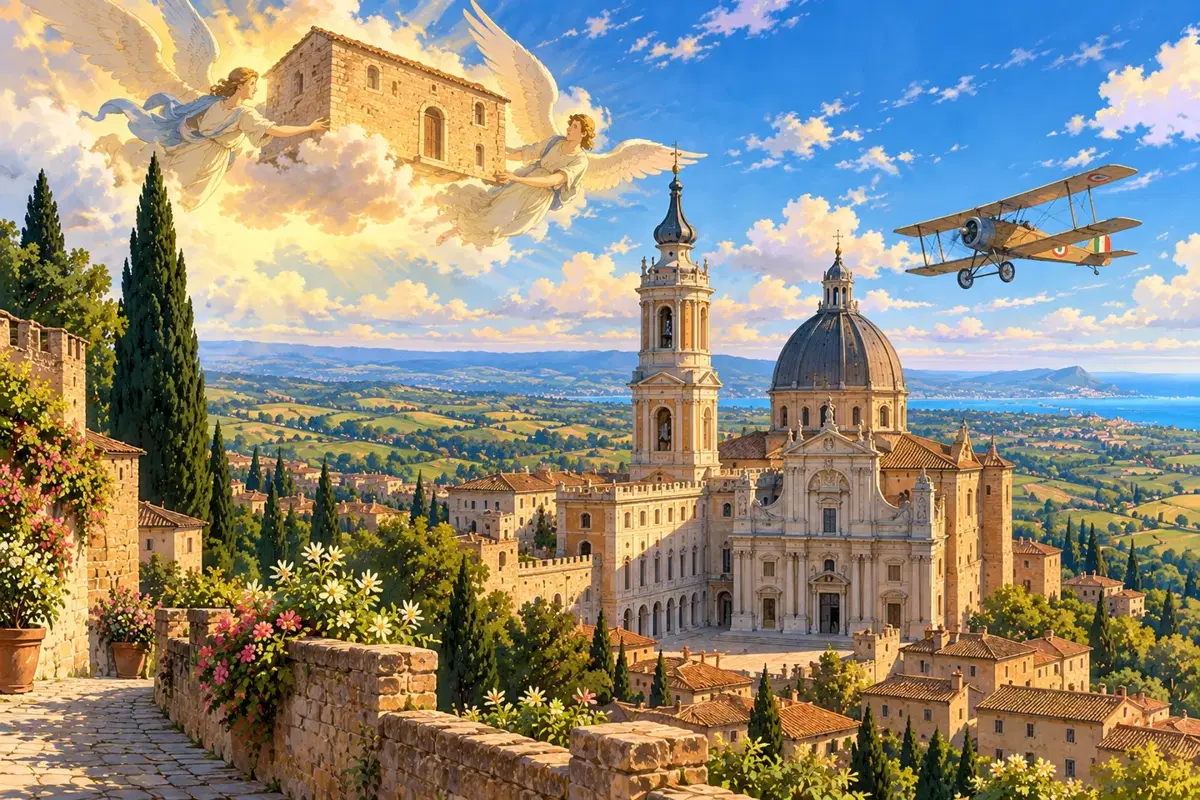
A travelling house in tradition
To understand why aviators look to Loreto, start with a religious account: the tradition of the Holy House carried by angels from Nazareth. Flight belongs to this devotional narrative; it is not a historical reconstruction of the stones’ journey. [1]
This image offered early pilots a clear point of reference: heavenly protection associated with movement through the air. The Air Force recalls that requests from First World War aviators also supported the call for official recognition. [1]
The recognition of 1920
The documented milestone is 24 March 1920: Benedict XV proclaimed Our Lady of Loreto patroness of air travellers. The date distinguishes the sanctuary’s long history from the much more recent establishment of this particular patronage connected with aviation. [1][2]
The feast is celebrated on 10 December. The connection also extends beyond military aviation: Vatican documentation discusses it in the context of civil aviation. The same page recalls a Loreto medal carried by astronaut James McDivitt on the 1969 Apollo 9 mission. [2]
Reading Loreto’s symbols on a visit
During your visit, consider these two periods together: the account of the translation and its reinterpretation in the age of aircraft. Seeing the Holy House from this perspective helps explain how an old symbol can continue to speak to modern professions. [1][2]
Plan entry using the sanctuary’s updates, especially during celebrations and pilgrimages. Check official guidance for opening times, access and personal requirements: this cultural visit takes place within an active place of worship whose spaces and prayer times should be respected. [3]