La Rancia Changed from a Fortified Farm into the Da Varano’s Military Stronghold
The castle just outside Tolentino did not begin simply as a fortress: its story starts with rural buildings transformed in the 14th century.
Sources consulted:
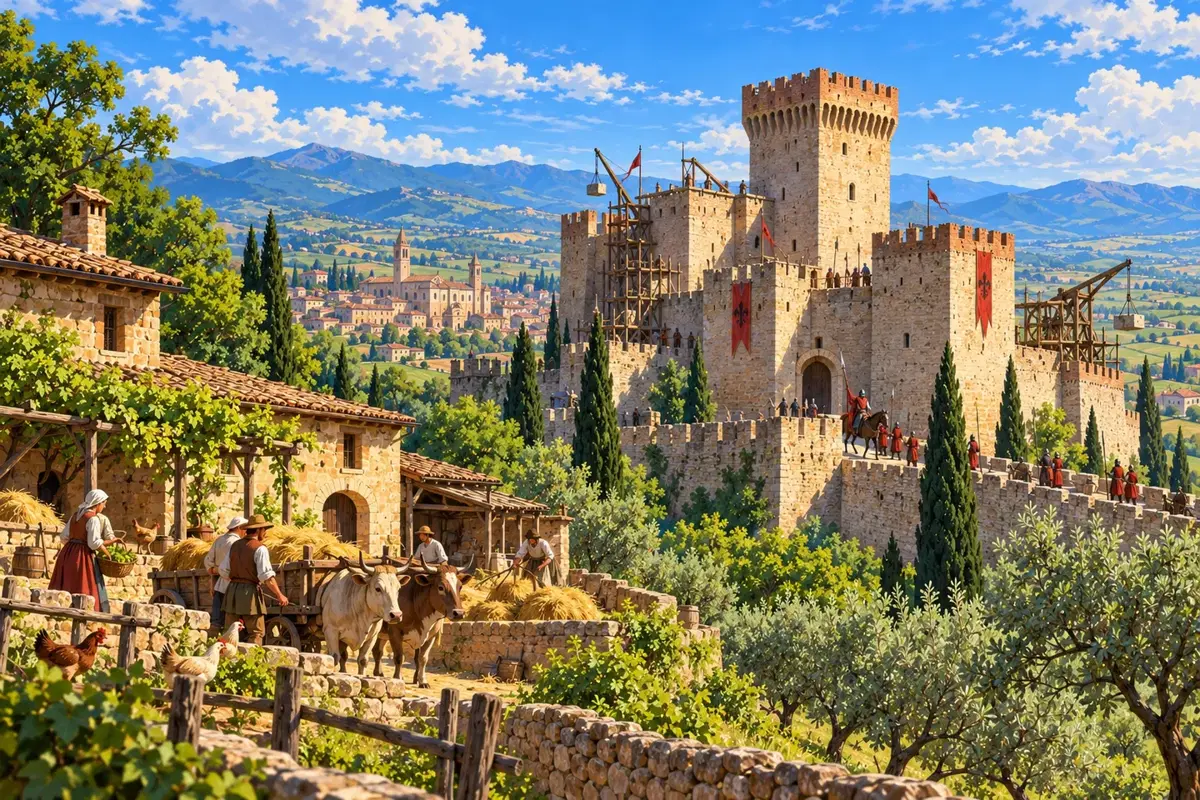
A name between fields and walls
Rancia Castle stands in the Chienti valley outside Tolentino. Its name is cautiously linked to granges, buildings used for agricultural storage. The civic museums present this as probable, distinguishing it from an undocumented suggestion of an old orange grove in the courtyard. [1]
The building’s origins also require care: the regional catalogue mentions a possible earlier tower-house. There is no need to turn a hypothesis into certainty. Its layered history brings together food storage, residence and control of the territory. [1][2]
The Da Varano transformation
Between 1353 and 1357 Rodolfo II Da Varano transformed the complex into a military structure also usable as a residence. Its position overlooked a valley route: considering fortress and landscape together explains the site better than examining walls alone. [1][2]
Keep, towers and protected entrance reveal defensive functions; other rooms reflect daily life and later changes. Tolentino’s municipality bought the castle in 1973. Today’s fortress is also the result of a public decision to conserve it and use it for culture. [1][2]
From battle to museums
On 2 and 3 May 1815 the area saw battle between Joachim Murat’s forces and the Austrians. This is distinct from the treaty Napoleon signed in Tolentino in 1797: linking the places is useful if the dates and events remain clear. [1]
Check the civic museums’ programme and accessibility of the spaces you want to reach, especially stairways. The castle also houses the Gentiloni Silverj Archaeological Museum, linking the building’s history to older local evidence and extending the visit beyond an exterior photograph. [1][3]